Al Maktoum International Airport (DWC) – Expansion Program
Project Overview
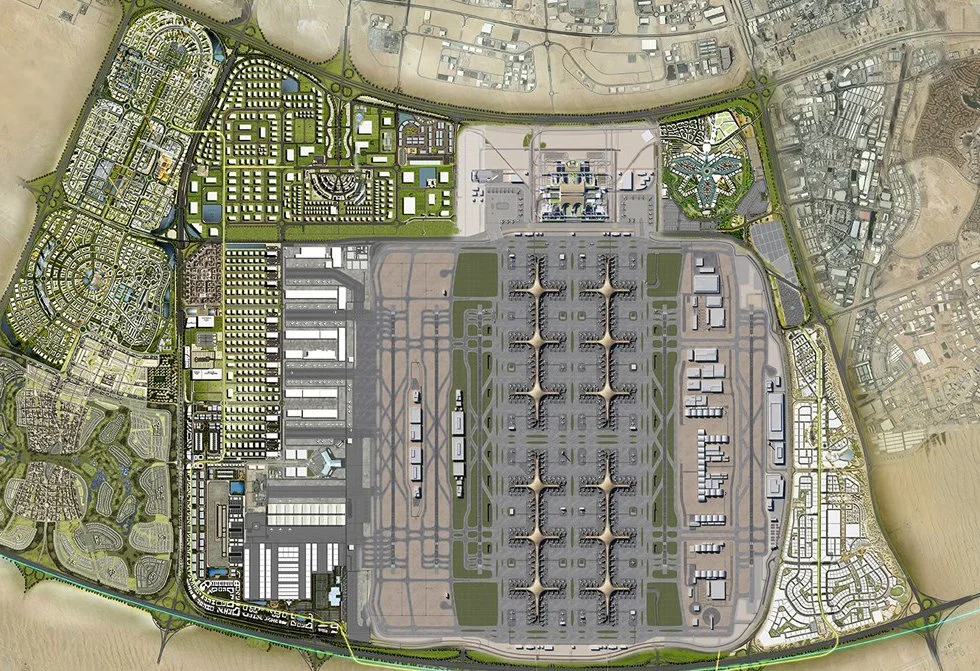
The Al Maktoum International Airport (DWC) expansion program represents one of the most ambitious aviation developments ever conceived — a $30B+ masterplanned airport intended to replace Dubai International Airport (DXB) as the primary global hub for Emirates Airlines. The program envisioned five parallel runways, multiple terminal complexes, and four large-scale concourses, each capable of handling up to 100 gates, supported by a fully integrated underground system for passengers, baggage, and ground operations.
The project sought to establish a new global benchmark for capacity, operational efficiency, and technology-enabled passenger experience.
Project Facts
Client: Dubai Aviation Engineering Projects (DAEP)
Location: Dubai, UAE
Program: New international airport (ultimate build-out)
Construction Value: ~$30B+
Scope: Airport-wide technology, security systems, operations centers, data centers
Role: Principal Architect (Technology & Systems Integration)
The Challenge
DWC presented a fundamentally different type of design challenge — one defined not only by scale, but by uncertainty and long-term technological evolution:
Planning for a next-generation airport with a 10+ year development horizon
Designing systems for technologies that were still evolving or not yet fully defined
Integrating airport-wide digital infrastructure, security systems, and passenger processing technologies at unprecedented scale
Coordinating across multiple terminal complexes, concourses, and underground operational systems
Aligning architectural, engineering, and technology strategies across a multi-billion-dollar, multi-phase program
The core challenge was not just to design systems — but to design a framework capable of adapting over time.
My Role
As Principal Architect for the technology subconsultant team, I served as the primary interface between the lead architect, engineering disciplines, and all technology and security systems across the program.
My role combined:
Design integration
Technology strategy
Client advisor
I was responsible for:
Leading the planning and integration of all airport-wide technology systems
Advising the client and design team on emerging technologies and future passenger processing models
Coordinating the design of operations centers, data centers, and digital infrastructure systems
Ensuring that technology systems were fully integrated into the architectural and spatial design of the airport
Key Contributions
Developed long-range technology integration strategy
Applied research, benchmarking, and forward-looking analysis to guide the integration of evolving technologies across a 10-year development horizon.Introduced “soft infrastructure” planning principles
Established flexible planning strategies that allowed systems — particularly passenger processing and digital environments — to evolve without requiring major physical redesign.Led integration of passenger-facing technologies
Defined planning and design approaches for biometric processing, security screening, and airport-wide digital content systems.Planned and designed critical infrastructure systems
Led coordination of two high-performance data centers and multiple operations control centers supporting airport-wide functionality.Bridged architecture and technology disciplines
Unified architectural, engineering, and technology teams around a coordinated design approach, ensuring that digital systems were seamlessly embedded within the built environment.Supported procurement and delivery strategy
Contributed to the development of a Master Systems Integrator (MSI) strategy to standardize and implement technology systems across the program.
Outcome
The DWC expansion program established a forward-looking framework for next-generation airport design, demonstrating how large-scale aviation infrastructure can:
Integrate rapidly evolving technologies into long-term planning
Decouple physical infrastructure from shorter technology lifecycles
Deliver highly efficient, scalable, and adaptable airport environments
The project positioned the client to pursue one of the most advanced and future-ready airport developments globally.